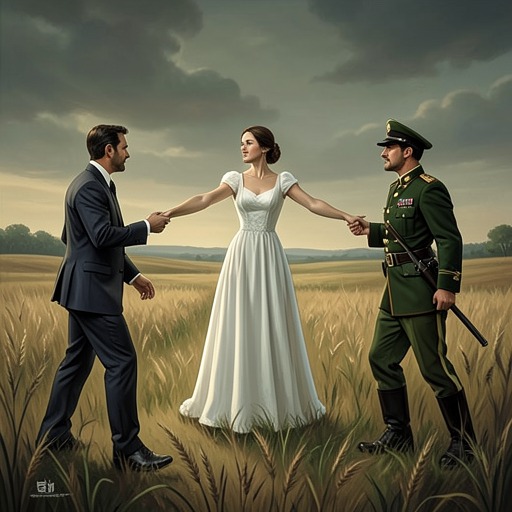
Narrator and Husband’s Marriage Relationship
Black Box (Jennifer Egan Edition)The Unnamed narrator’s marriage is both an intimate home life and a source of resolve in Black Box: her husband understands and applauds her patriotism, and their shared conviction makes her dangerous service possible, while the prospect of returning to him gives that service an emotional horizon. The relationship is defined by affection and mutual allegiance, but also by a paradox the narrator cannot settle: she must come home as the same person she was when she left, even though change is guaranteed—and had begun before her departure.
A shared life and divided allegiances
The narrator recalls an enclosed, joyful life with her husband that began in graduate school. That shared history gives the marriage a settled intimacy; it is not merely a future reward she imagines, but a life they have already built together. The story sets this private world beside the public demands of the narrator’s patriotism without making the two loyalties opposites. Her husband comes from a culture of tribal allegiance, yet he understands and applauds her service. His response makes her commitment legible within the marriage rather than a cause of estrangement.
His own attachment to the United States further complicates any simple division between the narrator’s national duty and their private bond. The United States is the country he chose, and he loves it. The narrator also recognizes that his rise to prominence would have been unimaginable in any other nation. His relationship to the country is therefore personal as well as political: it is connected to the life and prominence he has been able to attain there. In this account, the marriage contains two forms of allegiance—her patriotism and his chosen national belonging—that can coexist and reinforce one another.
Service as a joint decision
The narrator understands her mission as a decision made within the marriage, not a private impulse detached from it. She and her husband share the conviction that their service had to be undertaken before they had children. The timing matters: their commitment is framed around a future family they do not yet have, and around the belief that this particular obligation belongs before that next stage of life. The text does not describe a debate between them or assign the decision to one spouse. Instead, it stresses their joint conviction.
The narrator’s age and working life give that choice a specific context. At thirty-three, she has spent her professional life fomenting musical trends, a career distinct from the service she is undertaking. The contrast marks the scale of the departure: the mission interrupts a life already shaped by professional purpose and by a long-standing marriage. Yet the husband’s support, and their shared judgment about when to serve, make the undertaking part of their common history rather than simply a rupture from it.
The hoped-for return and the altered self
The narrator repeatedly measures the mission against the hope of coming home. She must return as the person she was when she left; at the same time, she has been guaranteed that she will not be the same person. The conflict is sharpened by her recognition that she had already stopped being that earlier self before leaving. The marriage thus stands at the crossing point between continuity and transformation: returning to her husband is a concrete hope, but neither the journey nor the person who began it can be treated as unchanged.
When the story imagines joy arising from the knowledge that the task will be complete and the narrator will return to the husband she adores, affection becomes a reason to endure the present as well as an image of the future. In the emergency instructions, she may imagine herself in his arms. The suggestion is deliberately intimate and bodily, but remains an instructed act of imagination; it does not establish that he is physically present. The same sequence offers other anchors—the apartment, a displayed hunting knife inherited from his grandfather, and the small tomatoes the narrator grows on her fire escape. Her husband belongs within this cluster of homeward images, associated not only with romantic devotion but with a shared domestic world of particular objects and routines.
Form and the marriage as an anchor
The author’s note describes Black Box as a spy-thriller version of a character drawn from the author’s novel A Visit From the Goon Squad. That genre shift places the marriage inside a story structured by lessons for a woman on a mission, rather than by straightforward narration of the action. The relationship consequently appears through remembered facts, practical conditions, and moments of imagined return. Its emotional force accumulates across these separate instructions: the shared life since graduate school, the husband’s understanding of her patriotism, the decision to serve before children, and the image of being held by him.
The story’s atomized design also fits the distance between a life the narrator values and a self that cannot simply be recovered. The author notes that the work was developed in a notebook with eight rectangles on each page and took a year to control and calibrate. In the finished form, the marriage is not presented as a long continuous scene; it is recalled in fragments that give the mission a private measure. Those fragments do not promise that the narrator will return unchanged. Instead, they show what she hopes to return to, and why the prospect remains meaningful even as she knows that both she and her marriage will meet her altered.